
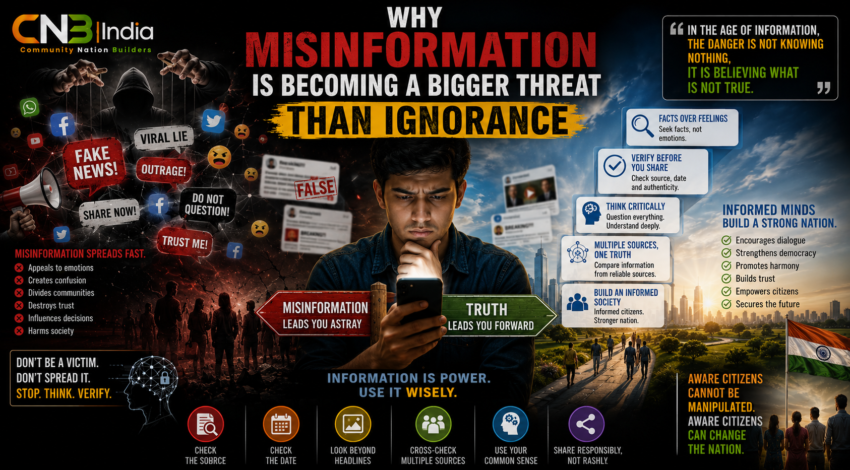
For centuries, ignorance was considered one of society’s greatest challenges.
A lack of knowledge often limited progress, slowed innovation, and prevented people from making informed decisions. Governments invested in education, institutions promoted awareness, and societies worked tirelessly to ensure that information became more accessible to ordinary citizens.
Today, humanity faces a very different problem.
Information is no longer scarce.
In fact, we are surrounded by it.
Every day, billions of people consume news, opinions, videos, posts, articles, podcasts, and messages through smartphones and digital platforms.
Yet despite having access to more information than any generation in history, society is becoming increasingly vulnerable to a dangerous new threat:
Misinformation.
In many ways, misinformation is more dangerous than ignorance because an ignorant person knows they do not know something.
A misinformed person believes they already know the truth.
And that difference can change everything.
Ignorance Can Be Corrected. Misinformation Is Often Defended.
An individual who lacks information is usually open to learning.
When presented with facts, evidence, or education, they often update their understanding.
Misinformation operates differently.
It gives people confidence in something that may be false, incomplete, or deliberately misleading.
As a result:
- False information is treated as truth.
- Opinions become stronger despite weak evidence.
- Corrections are rejected.
- Facts become secondary to beliefs.
The challenge is not merely the absence of knowledge.
It is the presence of incorrect knowledge.
And correcting misinformation is often far more difficult than educating someone who simply lacks information.
Social Media Has Changed the Information Landscape
In the past, news primarily came from newspapers, television, radio, and established institutions.
Today, information travels through:
- Social media platforms
- Messaging applications
- Influencers
- Online communities
- Short-form videos
- Anonymous accounts
Anyone can publish content.
Anyone can create a narrative.
Anyone can influence public opinion.
This democratization of information has many benefits.
However, it also means that false information can spread faster than ever before.
A misleading post can reach millions of people within hours.
By the time corrections emerge, the damage may already be done.
Emotional Content Travels Faster Than Facts
One reason misinformation spreads so effectively is because it often appeals to emotions.
People are more likely to share content that triggers:
- Anger
- Fear
- Outrage
- Excitement
- National pride
- Personal beliefs
Facts require analysis.
Emotions demand immediate reactions.
As a result, sensational claims frequently travel faster than verified information.
A dramatic falsehood often receives more attention than a complicated truth.
This creates an environment where engagement is rewarded more than accuracy.
The Rise of Confirmation Bias
Human beings naturally prefer information that supports their existing beliefs.
Psychologists refer to this as confirmation bias.
People often:
- Accept information they agree with.
- Question information they dislike.
- Ignore evidence that challenges their worldview.
Social media algorithms amplify this tendency.
Platforms continuously show users content similar to what they have already engaged with.
Over time, individuals may find themselves living inside digital echo chambers where they encounter only one side of an issue.
The result is not greater understanding.
It is greater polarization.
Misinformation Influences Society in Real Ways
Some people view misinformation as merely an online problem.
The reality is much more serious.
False information can influence:
- Elections
- Public health decisions
- Social harmony
- Economic behavior
- Community relations
- National security
A rumor shared online can create panic.
A manipulated video can damage reputations.
A false narrative can deepen divisions between communities.
In the digital age, misinformation has consequences far beyond screens.
Young People Are Especially Vulnerable
India’s youth are among the most connected populations in the world.
They consume vast amounts of information every day.
However, digital literacy has not always grown at the same pace as digital access.
Many young people encounter:
- Edited videos
- Misleading headlines
- Fake statistics
- AI-generated content
- Political propaganda
- Conspiracy theories
Without strong critical-thinking skills, distinguishing fact from fiction becomes increasingly difficult.
The challenge facing modern youth is no longer finding information.
It is identifying trustworthy information.
Artificial Intelligence Is Making the Problem More Complex
Artificial intelligence has created remarkable opportunities for innovation and productivity.
At the same time, it has introduced new challenges.
Today, technology can generate:
- Realistic images
- Synthetic voices
- Fake videos
- Automated articles
- Fabricated conversations
As these technologies become more sophisticated, verifying authenticity becomes more difficult.
The future may witness a world where seeing is no longer believing.
This makes media literacy and critical thinking more important than ever.
A Society Cannot Function Without Trust
Every society depends on trust.
Citizens trust:
- Institutions
- Experts
- Journalists
- Courts
- Scientists
- Public officials
When misinformation becomes widespread, trust begins to erode.
People no longer know:
- What is true.
- Who to believe.
- Which sources are credible.
This creates confusion and division.
A society that loses trust in facts risks losing trust in itself.
Critical Thinking Is the Best Defense
The solution to misinformation is not censorship alone.
Nor is it simply consuming more information.
The most effective defense is critical thinking.
Citizens must learn to ask:
- What is the source?
- Is this information verified?
- Are multiple sources reporting the same thing?
- Is the content designed to inform or provoke?
- Could there be missing context?
Healthy skepticism is not cynicism.
It is responsible citizenship.
In the information age, questioning responsibly is a necessity.
Why This Matters for India’s Future
India is emerging as one of the world’s most influential nations.
Its future will be shaped by:
- Technology
- Innovation
- Democracy
- Economic growth
- Social cohesion
Each of these depends upon informed citizens.
A country cannot make wise decisions if public discourse is dominated by misinformation.
The strength of a democracy is not measured by how loudly people speak.
It is measured by how accurately they understand reality.
An informed population is one of the greatest assets any nation can possess.
Conclusion
For generations, ignorance was viewed as society’s greatest obstacle.
Today, misinformation may be an even greater threat.
Ignorance leaves people uninformed.
Misinformation leaves people convinced of things that may not be true.
In a world overflowing with information, knowledge alone is no longer enough.
Citizens must develop the ability to evaluate, verify, and think critically.
Because the future will not belong to those who consume the most information.
It will belong to those who can distinguish truth from noise.
And in an age where misinformation spreads at the speed of a click, that ability may become one of the most important skills of all.