
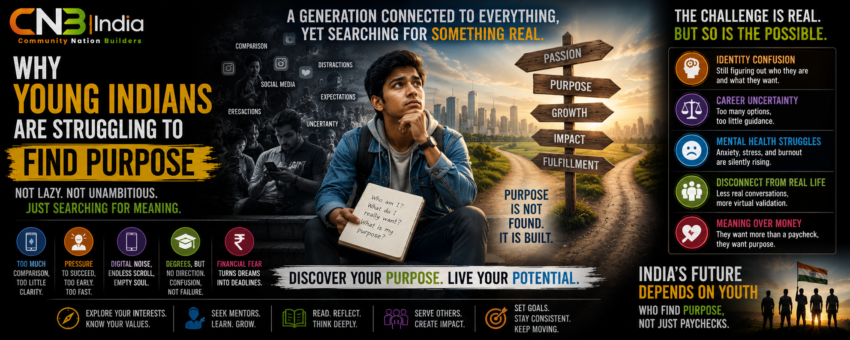
India is often described as a young nation.
With one of the largest youth populations in the world, the country possesses an extraordinary demographic advantage. Millions of young Indians are studying, working, innovating, creating businesses, and dreaming of a brighter future. They are more educated, more connected, and more technologically empowered than any generation before them.
Yet beneath this promise lies a growing and often overlooked reality:
Many young Indians are struggling to find purpose.
Despite unprecedented access to information, opportunities, and technology, a significant number of young people feel directionless, uncertain, and disconnected from a larger sense of meaning.
The question is no longer whether young people are ambitious.
The question is:
Why are so many ambitious young people feeling lost?
Success Has Become Easier to See but Harder to Understand
Previous generations had relatively clear definitions of success.
For many families, success meant:
- Completing education
- Securing a stable job
- Supporting family
- Building financial security
Today’s youth live in a completely different world.
Social media exposes them daily to:
- Entrepreneurs becoming millionaires
- Influencers gaining fame overnight
- Luxury lifestyles
- Startup success stories
- Global opportunities
Success appears everywhere.
Yet the path to achieving it often remains unclear.
Young people see thousands of destinations but very few roadmaps.
As a result, many constantly compare themselves to others while struggling to define what success actually means for themselves.
The Pressure to Succeed Has Never Been Higher
Indian youth face enormous expectations.
Families expect academic excellence.
Society expects career success.
Social media expects visible achievement.
Peers expect constant progress.
Many young people feel they are being evaluated continuously.
Questions such as:
- What are you doing?
- Which company do you work for?
- How much do you earn?
- When are you getting promoted?
- What are your future plans?
become part of everyday life.
While ambition can be motivating, constant pressure can also create anxiety and confusion.
When success becomes a race, purpose often gets left behind.
Social Media Has Replaced Reflection
Purpose is rarely discovered through constant distraction.
It usually emerges through:
- Reflection
- Experience
- Self-awareness
- Meaningful relationships
- Personal growth
Unfortunately, modern youth spend much of their time in environments designed to capture attention rather than encourage reflection.
Every day is filled with:
- Notifications
- Reels
- Viral content
- Online debates
- Endless scrolling
Young minds are consuming more information than ever before.
But consuming information is not the same as understanding oneself.
Many young people know what is trending globally but struggle to answer a simple question:
“What do I truly want from my life?”
Degrees No Longer Guarantee Direction
For decades, education was viewed as the primary pathway toward stability and success.
While education remains essential, it no longer guarantees clarity.
Many graduates today find themselves asking:
- Did I choose the right career?
- Is this work meaningful?
- Am I passionate about what I do?
- Is this what I want for the next thirty years?
The modern economy offers countless options but also creates decision paralysis.
When opportunities become endless, choosing a direction becomes more difficult.
As a result, many young professionals feel trapped between security and purpose.
The Decline of Community and Mentorship
In earlier generations, young people often received guidance from:
- Families
- Teachers
- Community elders
- Religious institutions
- Local role models
Today, these traditional support systems have weakened in many places.
At the same time, digital influencers have become increasingly influential.
While some provide valuable guidance, many focus primarily on popularity, wealth, appearance, or entertainment.
Young people are receiving more advice than ever before.
But not necessarily more wisdom.
Purpose often develops through mentorship, meaningful conversations, and real-life experiences—not simply through online content.
Financial Pressure Is Changing Priorities
Economic realities also play a major role.
Many young Indians face concerns regarding:
- Employment
- Rising living costs
- Housing affordability
- Family responsibilities
- Student loans
- Financial security
Under such pressure, survival often takes priority over purpose.
People choose jobs for stability rather than passion.
They postpone dreams to meet immediate obligations.
Over time, this can create a feeling that life is being managed rather than truly lived.
The struggle is not always about money itself.
It is about balancing financial responsibility with personal fulfillment.
Purpose Cannot Be Found Through Comparison
One of the biggest mistakes young people make is believing purpose can be copied.
Purpose is deeply personal.
What brings fulfillment to one person may feel meaningless to another.
Some find purpose through:
- Entrepreneurship
- Public service
- Education
- Art
- Science
- Family
- Community work
- Innovation
There is no universal formula.
Yet social media often encourages comparison instead of self-discovery.
Young people begin chasing goals because they are popular, not because they are meaningful.
The result is achievement without satisfaction.
India Needs Purpose-Driven Youth
A nation’s future depends not only on skilled citizens but also on purposeful citizens.
India needs young people who are driven by more than income and status.
The country needs:
- Innovators solving real problems
- Entrepreneurs creating jobs
- Teachers shaping future generations
- Scientists pushing boundaries
- Volunteers strengthening communities
- Responsible citizens contributing to society
Purpose transforms ambition into contribution.
It gives direction to talent.
And it converts personal success into social impact.
How Young People Can Rediscover Purpose
Purpose rarely appears overnight.
It develops gradually through exploration and experience.
Young people can begin by:
- Spending time away from constant digital distractions
- Identifying personal values
- Pursuing meaningful goals
- Serving others
- Developing skills consistently
- Seeking mentors
- Reading deeply
- Reflecting regularly
Most importantly, they must understand that purpose is not something found instantly.
It is something built over time.
Purpose Is Bigger Than a Job Title
One of the greatest misconceptions of modern life is the belief that purpose and profession are identical.
A job provides income.
Purpose provides meaning.
The two can overlap, but they are not always the same.
A person may work as an engineer and find purpose in community service.
A teacher may find purpose in shaping young minds.
An entrepreneur may find purpose in creating opportunities for others.
Purpose is not about what appears on a business card.
It is about the impact a person chooses to create.
Conclusion
India’s youth possess immense talent, energy, and potential.
But talent alone is not enough.
Without purpose, even success can feel empty.
The challenge facing many young Indians today is not a lack of opportunity.
It is a lack of clarity amidst overwhelming choices, constant comparison, and relentless pressure.
The solution is not to abandon ambition.
The solution is to connect ambition with meaning.
Because careers create livelihoods.
Success creates recognition.
But purpose creates fulfillment.
And in the end, a generation that discovers its purpose has the power not only to transform its own future but also the future of the nation itself.