
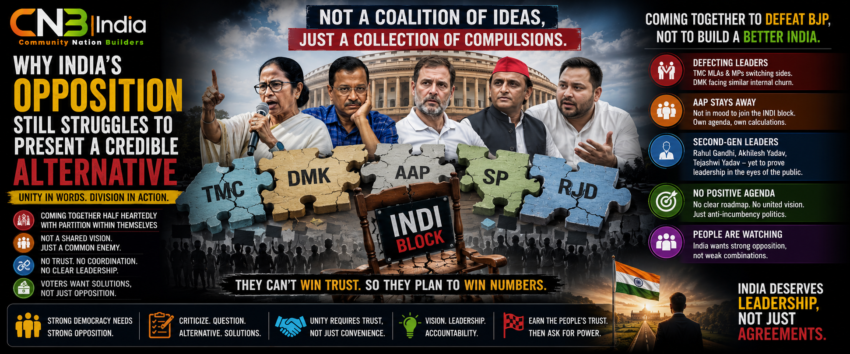
Democracy functions best when there is both a strong government and a strong opposition. While the ruling party governs, the opposition’s role is to provide accountability, offer alternative policies, and present a competing vision for the nation’s future.
In India today, the ruling party, the Bharatiya Janata Party (BJP), continues to dominate national politics. Despite the formation of opposition alliances and repeated efforts to unite against the BJP, many voters continue to question whether the opposition has succeeded in presenting itself as a cohesive and credible alternative.
The issue is not merely electoral arithmetic.
It is increasingly becoming a question of leadership, unity, vision, and public confidence.
Unity Against Someone Is Different from Unity for Something
Many opposition parties have attempted to come together under broader alliance frameworks with the primary objective of challenging the BJP.
However, political alliances are most successful when they are built around:
- A shared vision
- Common policy goals
- A coherent national agenda
- Strong organizational coordination
When alliances appear focused primarily on defeating a common opponent rather than presenting a positive alternative, voters often remain unconvinced.
Citizens generally want to know:
- What is the alliance’s economic vision?
- What are its plans for employment?
- How will it address national security?
- What reforms does it propose?
- How will coalition partners govern together?
Without clear answers, alliances risk appearing reactive rather than visionary.
Internal Contradictions Continue to Weaken Opposition Unity
One of the biggest challenges facing opposition politics is the presence of competing regional interests.
Several regional parties are strong within their respective states but have differing political priorities nationally.
In many cases:
- Regional leaders compete for influence.
- Parties oppose each other in state politics while cooperating nationally.
- Leadership ambitions remain unresolved.
- Cadres often struggle to work together on the ground.
These contradictions create an impression that opposition unity is tactical rather than ideological.
Voters tend to notice when political cooperation appears temporary or driven primarily by electoral necessity.
Leadership Remains an Unresolved Question
A major challenge for the opposition is the absence of a universally accepted national leader.
Several second-generation leaders remain influential within their parties, including:
- Rahul Gandhi
- Akhilesh Yadav
- Tejashwi Yadav
These leaders have substantial political experience and continue to play important roles in their respective political organizations.
However, critics argue that they have yet to establish the kind of nationwide public appeal, electoral dominance, or administrative credibility that would position them as a consensus national alternative.
Leadership in modern politics requires more than inheritance or party position.
It requires:
- Consistent public trust
- Electoral success
- Governance credentials
- Strong communication skills
- A compelling national vision
Many voters remain uncertain about who would lead a broad opposition coalition if it were to come to power.
Regional Success Does Not Automatically Translate Nationally
Several opposition parties remain highly successful within their own states.
For example:
- Trinamool Congress remains influential in West Bengal.
- Dravida Munnetra Kazhagam (DMK) remains a major force in Tamil Nadu.
- Samajwadi Party retains significance in Uttar Pradesh.
- Rashtriya Janata Dal remains influential in Bihar.
However, success within a state does not necessarily translate into national acceptance.
National leadership requires the ability to connect with voters across:
- Different languages
- Different regions
- Different economic groups
- Different political priorities
This remains one of the opposition’s most significant challenges.
Frequent Defections Raise Questions About Organizational Strength
Another issue affecting public perception is the recurring movement of leaders and legislators between political parties.
When elected representatives switch parties, voters often interpret it as:
- Internal dissatisfaction
- Weak organizational cohesion
- Leadership challenges
- Lack of ideological commitment
Political defections are not unique to opposition parties and occur across India’s political spectrum. However, repeated defections can create the perception that a party lacks internal stability.
Strong political organizations are usually able to retain talent, manage internal disagreements, and maintain long-term loyalty.
The AAP Factor and Opposition Coordination
The position of the Aam Aadmi Party (AAP) has also complicated broader opposition coordination at various points.
While parties may cooperate on specific issues, differences over regional interests, leadership questions, and electoral strategies often make long-term coordination difficult.
This highlights a larger challenge:
An alliance is not merely about bringing parties together.
It is about ensuring they remain together when difficult decisions arise.
The June 8, 2026 INDIA Bloc Meeting: Unity on Stage, Questions Behind the Scenes
The INDIA bloc’s high-profile meeting held at the Constitution Club in New Delhi on June 8, 2026, was intended to project opposition unity and demonstrate that the alliance remained politically relevant ahead of future electoral battles. Senior leaders including Rahul Gandhi, Mamata Banerjee, Akhilesh Yadav, and Tejashwi Yadav attended the meeting alongside representatives of several opposition parties.
However, despite the public display of unity, media reports highlighted several underlying concerns.
Most notably, the absence of the DMK and the distancing of AAP from the alliance became major talking points. Reports indicated that despite outreach efforts, DMK chose not to participate in the meeting, while AAP continued to maintain its distance from the bloc.
The meeting also reportedly witnessed regional allies and Left parties expressing concerns regarding Congress’s approach toward alliance partners. Leaders from regional parties emphasized the need for Congress to be more accommodating and collaborative if the alliance wished to remain effective.
While photographs and public interactions attempted to showcase solidarity, political observers noted that the alliance still appeared to be struggling with leadership questions, coordination issues, and differing regional priorities. Reports suggested that discussions involved not only issues against the government but also concerns regarding the alliance’s own functioning.
For many voters, the meeting reinforced an existing perception: that opposition parties are able to gather on a common platform, but are yet to convince the public that they possess a unified roadmap, a clear leadership structure, and a shared national vision.
A Leadership Question That Remains Unanswered
Another issue that continues to surface is leadership. While leaders such as Rahul Gandhi, Akhilesh Yadav, and Tejashwi Yadav remain among the most visible faces of the opposition, many political analysts argue that the alliance has yet to present a nationally accepted leadership model capable of matching the electoral appeal and organizational machinery of the BJP.
The challenge is not merely defeating a ruling party. It is persuading voters that an alternative government would be more cohesive, stable, and effective.
Voters Reward Confidence and Stability
One reason dominant political parties often maintain support is the perception of stability.
Many voters prioritize:
- Strong leadership
- Predictability
- Organizational discipline
- Clear decision-making
Even citizens who criticize aspects of the government may hesitate to support alternatives if they perceive those alternatives as fragmented or uncertain.
The opposition’s challenge is therefore not simply criticizing the government.
It is demonstrating that it can govern effectively, cohesively, and confidently.
Opposition Is Essential for Democracy
Criticism of opposition shortcomings should not be confused with opposition irrelevance.
A healthy democracy requires:
- Strong debate
- Policy scrutiny
- Accountability
- Alternative viewpoints
The presence of an effective opposition ultimately strengthens governance by ensuring that governments remain answerable to citizens.
India benefits when both the ruling party and opposition remain strong, competitive, and focused on public welfare.
Conclusion
The challenge facing India’s opposition is larger than forming alliances or holding joint rallies.
The real challenge is convincing voters that it represents a coherent, stable, and forward-looking alternative.
Until opposition parties can:
- Present a unified vision,
- Resolve leadership questions,
- Reduce internal contradictions,
- Strengthen organizational discipline,
- And focus as much on governance solutions as electoral politics,
many voters may continue to view their unity as tactical rather than transformational.
In modern politics, defeating a strong opponent requires more than opposition.
It requires credibility, clarity, leadership, and a compelling vision for the future.
And ultimately, that is the standard by which voters judge every political alternative.