
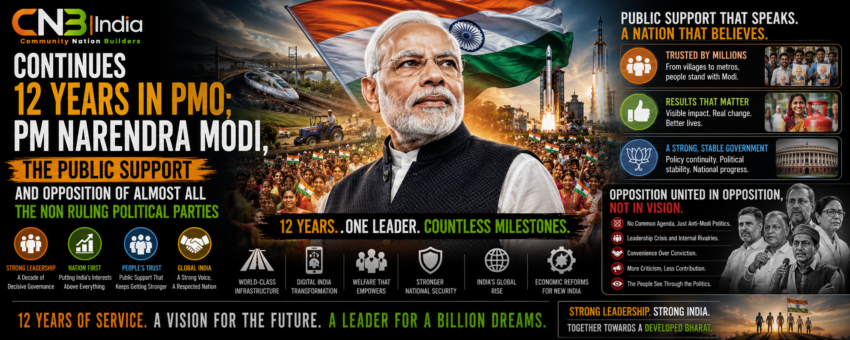
In democratic politics, longevity at the top is rare.
Governments come and go. Political fortunes rise and fall. Public sentiment shifts. Yet, some leaders manage to sustain their relevance despite intense scrutiny, criticism, and electoral challenges.
As India completes more than twelve years under the leadership of Prime Minister Narendra Modi, one question continues to dominate political discussions:
How has Narendra Modi remained India’s most influential political leader despite facing opposition from nearly every major non-ruling political party?
The answer lies not in a single factor, but in a combination of leadership style, public perception, political messaging, organizational strength, welfare initiatives, and the inability of the opposition to present a compelling alternative.
From 2014 to 2026: A Remarkable Political Journey
When Narendra Modi first entered the Prime Minister’s Office in 2014, he positioned himself as a leader promising decisive governance, economic development, administrative reforms, and a departure from coalition-era political uncertainty.
The slogan of “Minimum Government, Maximum Governance” resonated with millions of voters seeking change.
Since then, India has witnessed:
- Large-scale infrastructure expansion
- Digital governance initiatives
- Financial inclusion programs
- Welfare schemes targeting the poor
- Expansion of India’s global diplomatic profile
- Significant investments in transportation and connectivity
- A stronger emphasis on national security
Supporters view these developments as evidence of strong leadership and policy continuity.
Critics, meanwhile, argue that economic challenges, unemployment concerns, and social polarization remain important issues that deserve equal attention.
Yet despite political debates, one reality remains difficult to ignore:
Narendra Modi continues to command significant public visibility and electoral appeal.
The Modi Brand Has Become Bigger Than Traditional Politics
One reason for Modi’s continued success is that he has evolved from being merely a political leader into a political brand.
For many supporters, Modi represents:
- Stability
- National pride
- Strong decision-making
- Development-focused governance
- International recognition for India
This personal connection with voters has often allowed him to communicate directly with citizens, bypassing traditional political narratives.
In many elections, voters have appeared to evaluate candidates not only on local factors but also through their perception of Modi’s leadership.
This has given the ruling party a significant political advantage.
Public Support Beyond Party Structures
Historically, Indian politics often revolved around caste equations, regional alliances, and coalition arithmetic.
While these factors remain important, Modi’s political appeal has frequently transcended traditional voter categories.
His supporters come from:
- Urban areas
- Rural regions
- Young voters
- Women beneficiaries of welfare schemes
- First-time voters
- Sections of the middle class
Government initiatives related to housing, sanitation, direct benefit transfers, cooking gas connections, and financial inclusion have helped create a direct relationship between the government and many beneficiaries.
Whether one supports or opposes these policies, their political impact has been substantial.
Why the Opposition Continues to Struggle
While the BJP has benefited from strong leadership and organizational discipline, the opposition faces a different challenge.
Most major opposition parties agree on one thing:
They want to challenge the BJP’s dominance.
However, beyond that common objective, significant differences remain.
These differences include:
- Leadership ambitions
- Regional rivalries
- Ideological differences
- Seat-sharing disputes
- Contrasting policy priorities
As a result, opposition unity often appears tactical rather than strategic.
Voters frequently ask:
What is the opposition’s vision beyond opposing Modi?
This question remains one of the biggest obstacles facing anti-BJP alliances.
The Leadership Vacuum
A major reason for Modi’s continued dominance is the absence of a widely accepted opposition leader capable of matching his national appeal.
Several opposition leaders remain influential in their respective regions.
However, national politics requires:
- Broad voter acceptance
- Organizational capability
- Consistent messaging
- Governance credibility
- Nationwide recognition
While leaders such as Rahul Gandhi, Akhilesh Yadav, Tejashwi Yadav, Mamata Banerjee, and others remain important political figures, opposition parties have yet to establish a consensus leadership model capable of competing with the BJP’s centralized structure.
The result is a leadership contrast that continues to shape public perception.
Opposition Unity: Convenience or Conviction?
One of the recurring criticisms directed at opposition alliances is that they often appear united against a leader rather than united around a vision.
Successful political coalitions generally require:
- Shared goals
- Common policies
- Mutual trust
- Long-term commitment
When voters perceive alliances as temporary arrangements created primarily to defeat an opponent, questions about stability naturally emerge.
This perception has repeatedly benefited the BJP, which presents itself as a more cohesive political force.
The Role of Criticism in Democracy
It is important to recognize that criticism of the government is not only legitimate but essential in a democracy.
Strong opposition:
- Ensures accountability
- Highlights policy shortcomings
- Represents alternative viewpoints
- Strengthens democratic institutions
Many of the government’s policies continue to face criticism from opposition parties, civil society groups, economists, and policy experts.
This debate is a normal and healthy part of democratic governance.
The challenge for the opposition is transforming criticism into a persuasive alternative vision.
The Modi Phenomenon: Political Communication Matters
Another key factor behind Modi’s longevity is communication.
Through public rallies, social media engagement, direct outreach programs, and carefully crafted messaging, Modi has maintained a strong public presence throughout his tenure.
In modern politics, perception often matters as much as policy.
A leader who consistently communicates purpose, confidence, and direction tends to inspire greater public trust than fragmented opponents struggling to present a unified message.
This communication advantage has become one of Modi’s most powerful political assets.
What the Future Holds
As India moves toward the next phase of its democratic journey, the political landscape will continue evolving.
The BJP’s long-term success will depend on its ability to:
- Deliver economic growth
- Create employment opportunities
- Address social challenges
- Meet rising public expectations
Similarly, the opposition’s future will depend on whether it can:
- Develop credible leadership
- Present a coherent vision
- Build durable alliances
- Focus on solutions rather than solely criticism
Indian voters have repeatedly demonstrated that they reward performance, leadership, and credibility over political calculations alone.
Conclusion
More than twelve years after entering the Prime Minister’s Office, Narendra Modi remains one of the most influential figures in contemporary Indian politics.
His continued popularity reflects a combination of leadership perception, political communication, welfare outreach, organizational strength, and public trust built over multiple election cycles.
At the same time, the opposition’s struggle highlights a larger reality of modern politics:
Defeating a dominant political force requires more than unity against a common opponent.
It requires a compelling vision, strong leadership, organizational discipline, and the ability to convince voters that a better alternative exists.
In the end, Indian democracy will continue to be shaped not only by the strength of those in power but also by the quality of those who seek to challenge them.