
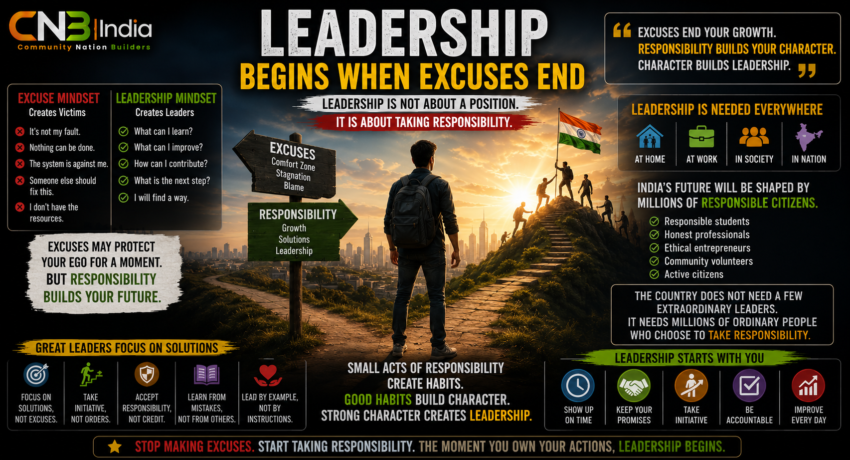
Every generation talks about leadership.
Schools teach it. Companies seek it. Governments depend on it. Communities admire it.
Yet many people misunderstand what leadership truly means.
Leadership is often associated with titles, authority, positions, and influence. People imagine leaders as CEOs, politicians, military commanders, or successful entrepreneurs.
But real leadership begins much earlier.
It begins at the moment a person stops making excuses and starts taking responsibility.
Because leadership is not about controlling others.
Leadership is about taking ownership.
And ownership begins where excuses end.
The Excuse Culture Is Growing
Modern society has become increasingly comfortable with excuses.
When things go wrong, people often look for someone else to blame.
They blame:
- The government
- The economy
- Their boss
- Their family
- Their education
- Their circumstances
- Society
- Luck
While challenges and obstacles certainly exist, constantly blaming external factors creates a dangerous mindset.
Excuses may protect the ego temporarily.
But they also prevent growth.
A person who blames everything around them eventually loses control over their own future.
Leadership requires a different approach.
Leaders ask:
“What can I do to improve this situation?”
Responsibility Is the First Step Toward Leadership
Every meaningful achievement begins with responsibility.
Before leading a team, a person must learn to lead themselves.
Before changing a community, they must change their habits.
Before demanding accountability from others, they must practice accountability themselves.
Leadership starts when an individual says:
- My actions matter.
- My choices matter.
- My effort matters.
- My response matters.
This mindset transforms people from spectators into participants.
And participants are the ones who create change.
Great Leaders Focus on Solutions
Every problem presents two options.
People can either:
- Discuss why something cannot be done.
- Focus on how it can be done.
The first approach creates excuses.
The second creates leadership.
History’s most respected leaders were rarely people with perfect circumstances.
They often faced:
- Limited resources
- Opposition
- Failure
- Uncertainty
- Criticism
What separated them from others was not the absence of challenges.
It was their refusal to let challenges become excuses.
They focused on solutions instead of limitations.
Excuses Create Victims. Responsibility Creates Leaders.
One of the biggest differences between successful people and unsuccessful people is how they respond to setbacks.
When faced with difficulties, some people immediately search for reasons why success is impossible.
Others search for ways to move forward despite the obstacles.
Victim thinking sounds like:
- “It’s not my fault.”
- “Nothing can be done.”
- “The system is against me.”
- “Someone else should fix this.”
Leadership thinking sounds like:
- “What can I learn from this?”
- “What can I improve?”
- “How can I contribute?”
- “What is the next step?”
The situation may be identical.
The mindset is completely different.
Leadership Is Needed Everywhere
Many people believe leadership only matters in positions of power.
The truth is that leadership is needed in every part of society.
A student can lead.
A teacher can lead.
A parent can lead.
A volunteer can lead.
An employee can lead.
A citizen can lead.
Leadership is not defined by position.
It is defined by behavior.
A person who consistently takes responsibility influences others regardless of title.
India’s Future Depends on Responsible Leadership
India is one of the youngest nations in the world.
Its future will not be determined solely by politicians, business leaders, or institutions.
It will be shaped by millions of ordinary citizens making daily decisions.
The country needs:
- Responsible students
- Honest professionals
- Ethical entrepreneurs
- Community volunteers
- Active citizens
Nation-building requires leadership at every level.
When individuals refuse to take responsibility, progress slows.
When individuals embrace responsibility, society moves forward.
India does not need a few extraordinary leaders.
It needs millions of responsible citizens willing to lead through action.
Social Media Has Made Excuses Easier
Modern technology has made it easier than ever to criticize.
People can express opinions instantly.
They can highlight problems, identify mistakes, and point out failures from the comfort of their screens.
Criticism has its place.
But criticism without contribution changes very little.
Real leadership asks a different question:
“What am I doing to help solve the problem?”
The future belongs not to those who complain the loudest.
It belongs to those who contribute the most.
The Best Leaders Lead by Example
People rarely follow instructions.
They follow examples.
The most respected leaders inspire trust because their actions match their words.
They:
- Show discipline
- Keep commitments
- Accept responsibility
- Learn from mistakes
- Stay accountable
Leadership is not about demanding excellence from others.
It is about demonstrating excellence consistently.
When excuses disappear, credibility grows.
And credibility is the foundation of influence.
Failure Is Not an Excuse
One reason people make excuses is fear of failure.
They worry that taking responsibility means accepting blame when things go wrong.
But leadership does not require perfection.
It requires courage.
Great leaders fail.
Great entrepreneurs fail.
Great innovators fail.
The difference is that they learn, adapt, and continue moving forward.
Failure becomes a lesson.
Excuses become a barrier.
Leadership Starts with Small Decisions
Many people wait for a major opportunity to become leaders.
Leadership rarely begins that way.
It starts with simple choices:
- Showing up on time.
- Keeping promises.
- Taking initiative.
- Solving problems.
- Helping others.
- Admitting mistakes.
- Improving continuously.
Small acts of responsibility create habits.
Those habits create character.
And character creates leadership.
Conclusion
The world does not have a shortage of opinions.
It has a shortage of people willing to take responsibility.
Every challenge, whether personal, professional, or national, can be approached in two ways.
One path is filled with excuses.
The other is filled with ownership.
Excuses may provide temporary comfort.
Responsibility creates lasting progress.
Leadership does not begin when someone receives a title.
It does not begin when people start following.
It begins the moment an individual decides to stop blaming circumstances and start taking ownership of outcomes.
Because at its core, leadership is simple:
Leadership begins when excuses end.