
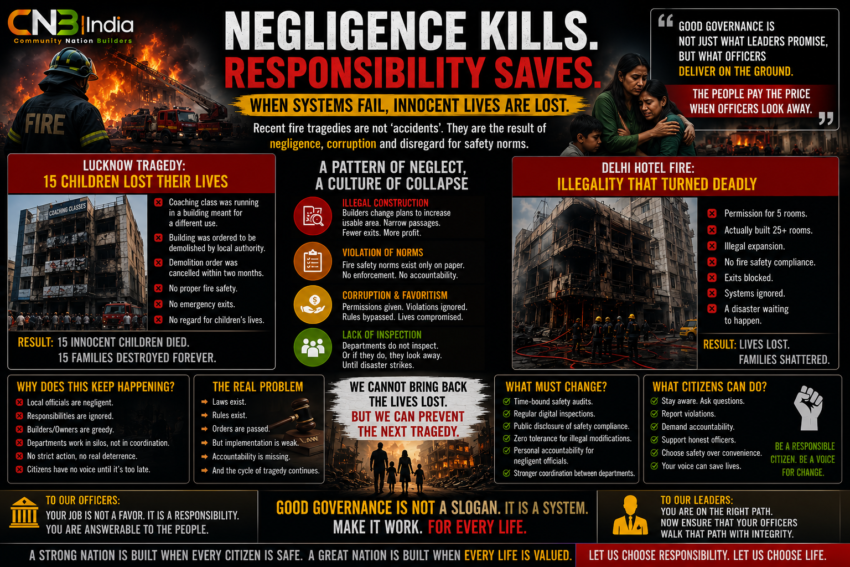
Every time a major fire breaks out in India, the same questions are asked.
Why were safety norms ignored?
Why were violations allowed to continue?
Why were illegal constructions not stopped?
Why did authorities act only after lives were lost?
And perhaps the most painful question of all:
Why does it take a tragedy for the system to wake up?
Recent fire incidents in different parts of India have once again exposed a disturbing reality. Many disasters that are described as “accidents” are often the result of years of negligence, weak enforcement, ignored warnings, and administrative failures.
The flames may start in a building.
But the real fire often begins long before that—in files, approvals, inspections, and decisions that were never taken seriously.
The Lucknow Tragedy: A Preventable Loss
The recent fire incident in Lucknow shocked the nation.
Young students who entered a coaching facility with dreams of building their future never returned home. Families lost their children. Parents lost their hopes. Lives were shattered forever.
What makes such tragedies even more painful is the growing public perception that many of these incidents could have been prevented.
Reports surrounding the incident raised serious questions about building usage, safety compliance, enforcement actions, and administrative oversight.
Whenever a building continues to operate despite concerns regarding safety or legality, the responsibility cannot rest solely on the owner.
The system responsible for enforcement must also answer difficult questions.
Because regulations are meaningless if they exist only on paper.
The Delhi Hotel Fire: A Familiar Story
Before Lucknow, another tragedy drew national attention.
Investigations into a hotel fire in Delhi reportedly highlighted serious concerns regarding construction permissions, occupancy levels, and compliance with safety regulations.
Across India, a familiar pattern often emerges after such incidents:
- Buildings exceed approved limits.
- Additional rooms are constructed.
- Emergency exits are blocked.
- Corridors become narrower.
- Fire-fighting systems remain inadequate.
- Occupancy exceeds safe capacity.
Yet these violations frequently continue for years without meaningful intervention.
The question is not whether rules exist.
The question is whether they are being enforced.
The Dangerous Culture of “Adjustments”
One of the biggest challenges facing urban India is the culture of unauthorized modifications.
Many building owners seek to maximize profits by increasing usable space.
This often leads to:
- Encroached passages
- Reduced emergency exits
- Additional floors
- Unauthorized rooms
- Blocked staircases
- Overloaded electrical systems
Every square foot added illegally may increase revenue.
But it can also reduce the margin of safety.
In emergencies, those missing passages and blocked exits can become the difference between life and death.
Unfortunately, by the time the consequences become visible, it is often too late.
Laws Are Not the Problem. Enforcement Is.
India does not lack building regulations.
India does not lack fire safety norms.
India does not lack planning regulations.
India does not lack approval mechanisms.
The real challenge often lies elsewhere.
Rules are frequently weakened by:
- Delayed inspections
- Poor coordination between departments
- Weak enforcement
- Administrative complacency
- Corruption
- Political influence
- Lack of accountability
After every tragedy, officials promise stricter action.
Inspections increase temporarily.
Notices are issued.
Committees are formed.
Then public attention fades, and the cycle often repeats itself.
Citizens Pay the Price for Administrative Negligence
One of the most frustrating aspects of these tragedies is that the people who suffer are often the ones who had no role in creating the violations.
The victims are:
- Students
- Families
- Hotel guests
- Workers
- Customers
- Ordinary citizens
They trust that buildings operating openly have been inspected.
They trust that authorities have verified compliance.
They trust that the system is protecting them.
When that trust is broken, innocent lives are placed at risk.
The cost of negligence is not measured in paperwork.
It is measured in human lives.
Good Governance Must Reach the Ground
Over the past decade, both central and state governments have repeatedly emphasized governance reforms, transparency, digital systems, accountability, and citizen-centric administration.
Many positive initiatives have been launched.
However, policies announced at the top are only as effective as their implementation at the local level.
A strong government policy means little if:
- Inspections are ignored.
- Violations are overlooked.
- Unsafe buildings continue operating.
- Warning signs go unaddressed.
Citizens experience governance not through speeches or announcements.
They experience governance through the actions of local officials who implement the rules.
The true test of governance is not policy creation.
It is policy enforcement.
Accountability Must Extend Beyond Builders
Whenever a tragedy occurs, building owners often face scrutiny.
And rightly so.
Those who violate safety norms must be held accountable.
But accountability cannot stop there.
Questions must also be asked of:
- Planning departments
- Municipal authorities
- Fire departments
- Inspection teams
- Licensing authorities
If violations existed for months or years, how were they missed?
If notices were issued, why were they not enforced?
If risks were identified, why were they not eliminated?
Accountability must include everyone responsible for public safety.
Prevention Is Always Cheaper Than Tragedy
Every disaster follows a similar timeline.
Warning signs appear.
Violations accumulate.
Complaints emerge.
Inspections may occur.
Action is delayed.
Then tragedy strikes.
Afterward, authorities spend enormous resources on:
- Investigations
- Compensation
- Legal proceedings
- Demolition drives
- Public inquiries
Yet many of these costs could be avoided through proactive enforcement.
Preventing a tragedy is always easier than explaining one.
What Must Change
India’s cities are growing rapidly.
Urbanization will continue.
Commercial buildings, coaching centers, hotels, hospitals, and residential complexes will increase.
This growth must be accompanied by stronger safety culture.
Key reforms should include:
- Time-bound safety audits.
- Regular digital inspections.
- Public disclosure of safety compliance.
- Zero tolerance for illegal modifications.
- Personal accountability for negligent officials.
- Faster action against repeat violators.
- Stronger coordination between departments.
Most importantly, safety should never be treated as a formality.
It must become a non-negotiable priority.
Conclusion
The recent tragedies in Lucknow, Delhi, and other cities are painful reminders that negligence has consequences.
Buildings do not become death traps overnight.
They become dangerous through years of ignored violations, weak enforcement, administrative complacency, and misplaced priorities.
India’s citizens deserve more than sympathy after a disaster.
They deserve systems that prevent disasters from happening in the first place.
Good governance is not measured by how effectively authorities respond after a tragedy.
It is measured by how successfully they prevent one.
Because every life lost due to preventable negligence is not merely a statistic.
It is a reminder that responsibility delayed can become responsibility denied.
And when responsibility is denied, innocent citizens pay the price.