
Every society faces challenges.
Roads need repair.
Traffic needs discipline.
Schools need improvement.
Cities need cleanliness.
Governments need accountability.
Communities need harmony.
Yet whenever something goes wrong, one response has become increasingly common:
“Someone else should fix it.”
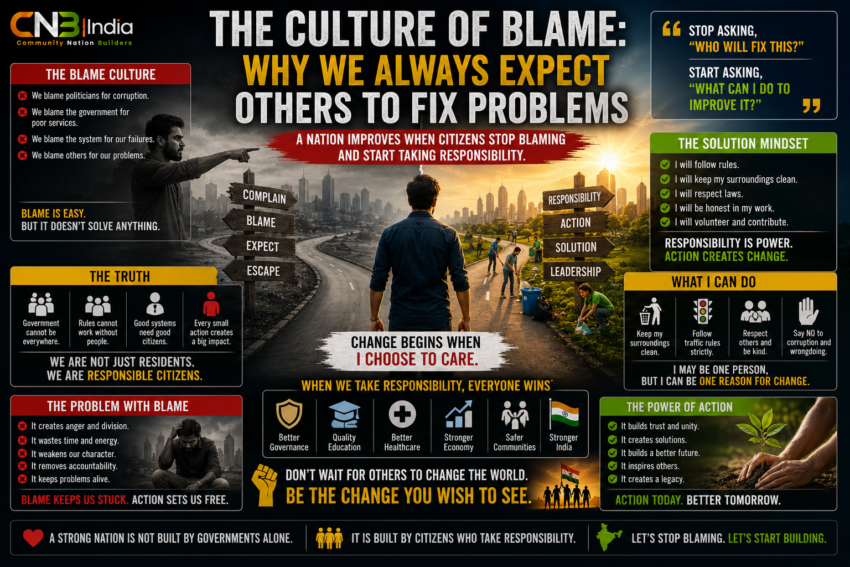
We blame politicians for corruption.
We blame officials for poor governance.
We blame the police for crime.
We blame teachers for declining education.
We blame parents for today’s youth.
We blame social media for changing society.
Sometimes these criticisms are justified.
But one important question often remains unanswered:
What responsibility are we willing to take ourselves?
A nation cannot progress if every citizen becomes an observer while expecting someone else to become the problem solver.
Blaming Others Is Easier Than Changing Ourselves
Human nature often seeks comfort.
Accepting responsibility requires effort.
Blaming others requires only words.
When we blame someone else, we temporarily protect ourselves from difficult questions.
Instead of asking,
“What could I have done differently?”
we ask,
“Who is responsible?”
The answer is often more complicated than a single individual or institution.
Most social problems are shared responsibilities.
And shared responsibilities require shared action.
Rights Are Discussed More Than Responsibilities
Modern society speaks frequently about rights.
We demand:
- Better roads.
- Cleaner cities.
- Safer neighborhoods.
- Honest governments.
- Efficient public services.
- Quality education.
These expectations are reasonable.
But rights and responsibilities must always exist together.
For example:
We demand clean streets.
Yet some people continue throwing garbage onto those same streets.
We demand disciplined traffic.
Yet many ignore traffic signals whenever convenient.
We demand honest governance.
Yet some still attempt to bypass rules through shortcuts and influence.
We cannot expect extraordinary public systems while accepting ordinary civic behavior.
Every Citizen Shapes Society
Many people believe that only governments build nations.
In reality, governments create policies.
Citizens create culture.
A country becomes cleaner because its citizens value cleanliness.
A country becomes safer because its people respect laws.
A country becomes stronger because ordinary individuals perform their duties honestly.
Every small action matters.
One responsible citizen inspires others.
One careless citizen can also influence many.
Nation-building is not the responsibility of governments alone.
It is the collective responsibility of society.
Social Media Has Created Instant Critics
Technology has given every individual a powerful voice.
Within seconds, anyone can criticize:
- Government decisions.
- Public officials.
- Businesses.
- Institutions.
- Society itself.
Constructive criticism is essential in every democracy.
It encourages accountability.
It exposes failures.
It promotes improvement.
However, criticism without contribution often changes very little.
The important question is not simply:
“Who made the mistake?”
It is also:
“What am I doing to improve the situation?”
Real change begins when criticism is followed by action.
Blame Cannot Replace Leadership
Leadership begins where excuses end.
Similarly, progress begins where blame ends.
Every successful organization encourages people to solve problems rather than simply identify them.
The same principle applies to society.
Leaders ask:
- How can we improve?
- What solution exists?
- Who will take responsibility?
- What action should begin today?
Followers often wait.
Leaders act.
The future belongs to societies that produce more problem-solvers than fault-finders.
Corruption Does Not Survive Alone
Many citizens rightly criticize corruption.
But corruption rarely exists in isolation.
It often survives because multiple people participate.
Someone offers a bribe.
Someone accepts it.
Someone ignores violations.
Someone remains silent.
Someone believes,
“Everyone does it.”
If citizens refuse to participate in corruption, corruption becomes far more difficult to sustain.
Fighting corruption requires honest institutions.
It also requires honest citizens.
Communities Improve When Citizens Participate
Every neighborhood faces challenges.
Parks need maintenance.
Schools require volunteers.
Road safety demands awareness.
Local issues require community participation.
Unfortunately, many people assume these responsibilities belong exclusively to government departments.
Strong societies are built when citizens actively participate alongside public institutions.
The most successful communities around the world often demonstrate one common characteristic:
People do not wait for someone else to begin.
They become part of the solution themselves.
India’s Future Depends on Responsible Citizens
India is transforming rapidly.
Modern infrastructure is expanding.
Technology is changing governance.
Public services are becoming increasingly digital.
Economic opportunities continue growing.
But no amount of development can replace responsible citizenship.
India’s future depends not only on:
- Better governments.
- Better policies.
- Better technology.
It also depends on:
- Honest taxpayers.
- Responsible drivers.
- Ethical professionals.
- Law-abiding citizens.
- Active communities.
Development is strongest when governments and citizens work together.
Neither can succeed fully without the other.
Change Always Begins with One Person
History rarely changes because everyone acts at once.
It usually changes because someone decides to act first.
A teacher inspires students.
A citizen reports corruption.
A volunteer cleans a neighborhood.
A young entrepreneur creates jobs.
A responsible officer refuses to compromise.
A parent teaches integrity.
Small actions create larger movements.
Large movements create national change.
Waiting for others delays progress.
Leading by example accelerates it.
Stop Asking “Who Will Fix This?”
Imagine if every citizen replaced one question.
Instead of asking,
“Who will fix this problem?”
they asked,
“What can I do to improve it?”
The answer may sometimes be small.
But millions of small actions produce extraordinary results.
Great nations are not built only by visionary leaders.
They are built by ordinary people who choose responsibility over excuses.
Conclusion
Blaming others may provide temporary satisfaction.
It rarely produces lasting solutions.
Every society needs accountability.
Governments must deliver.
Institutions must perform.
Public officials must uphold their duties.
But citizens also have a responsibility that cannot be delegated.
The culture of blame ends when the culture of responsibility begins.
Real progress starts when people stop waiting for someone else to solve every problem and begin contributing to the solution themselves.
Because every great nation is built not by people who ask,
“Why isn’t someone doing something?”
But by people who quietly say,
“I will do my part.”
And that simple decision has the power to transform families, communities, and ultimately, the nation itself.