
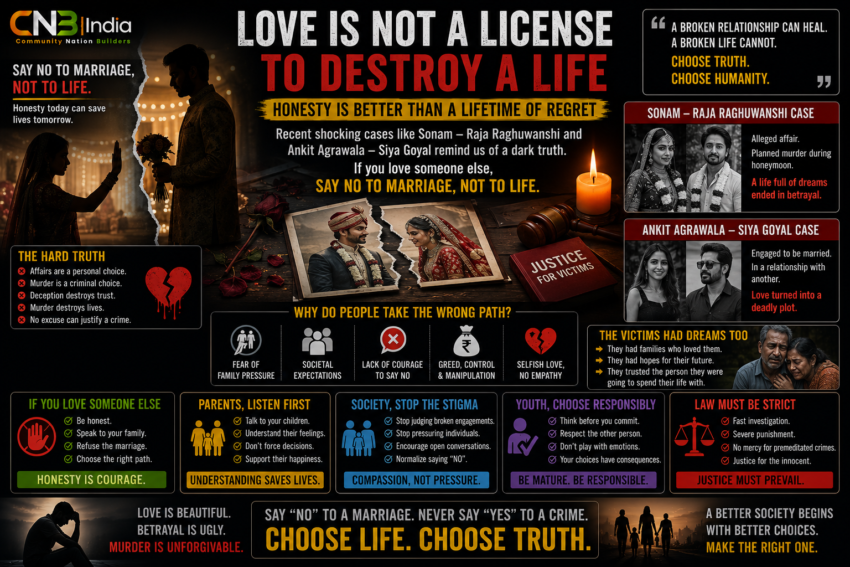
Marriage is built on one simple foundation:
Trust.
Two families come together believing that two individuals have chosen to begin a new chapter of life with honesty, respect, and commitment.
But in recent months, India has witnessed deeply disturbing criminal cases in which people allegedly murdered their spouse or fiancé while secretly maintaining another relationship. These incidents have shocked the nation—not only because of their brutality, but because they appear to have been entirely preventable if honesty had prevailed.
The question many citizens are asking is simple:
If someone does not want to marry, why not simply refuse the marriage instead of destroying innocent lives?
Marriage Must Never Be Forced
Every individual has the right to choose whom they wish to marry.
Likewise, every individual has the right to refuse a marriage.
Family pressure…
Social expectations…
Fear of disappointing parents…
Community traditions…
None of these justify entering a marriage against one’s will.
An unhappy marriage can be prevented.
A murder cannot be undone.
Saying “No” may be emotionally difficult.
But it is infinitely better than allowing an innocent person to become the victim of deception or violence.
Love Cannot Justify Crime
Police investigations into recent high-profile cases have alleged that personal relationships outside the engagement or marriage played a role in the crimes. These investigations are ongoing, and the courts will ultimately determine criminal responsibility.
Regardless of the outcome of any individual case, one principle remains universal:
Love never justifies murder.
If a person loves someone else, there are lawful and ethical choices available:
- Refuse the marriage.
- End the engagement honestly.
- Speak to family members.
- Seek counselling.
- Accept temporary conflict.
None of these options are easy.
But every one of them is better than taking an innocent life.
Families Must Listen Before They Decide
In many Indian households, marriage remains a family decision as much as a personal one.
Parents naturally want the best for their children.
However, one question should always be answered honestly before a wedding is finalized:
Does the bride genuinely want this marriage?
Does the groom genuinely want this marriage?
Silence should never be interpreted as consent.
Young people should feel safe expressing disagreement without fear of humiliation or emotional pressure.
An unwilling marriage benefits no one.
The Victims Had Dreams Too
Behind every headline is a family whose life changes forever.
Parents lose sons or daughters.
Siblings lose lifelong companions.
Friends lose someone they trusted.
The victims in these cases were planning weddings, building careers, making future plans, and preparing for a new beginning.
Instead, their families found themselves arranging funerals instead of celebrations.
No disagreement over marriage can justify such irreversible suffering.
Relationships Must Be Built on Truth
Modern India offers greater personal freedom than ever before.
Young people today have more opportunities to choose their education, careers, and partners.
With greater freedom comes greater responsibility.
If someone is already committed to another relationship, honesty becomes even more important.
Deception rarely solves problems.
It usually creates much bigger ones.
Truth may hurt temporarily.
Lies can destroy lives permanently.
This Is Not About Men or Women
It is important that society does not reduce these incidents to a battle between genders.
History has seen crimes committed by both men and women.
The issue is not gender.
The issue is character.
The issue is honesty.
The issue is respect for human life.
Every individual deserves safety, dignity, and the freedom to make informed decisions about marriage.
Justice must remain based on evidence and due process—not stereotypes.
Society Must Remove the Stigma of Saying “No”
One reason some people hesitate to reject arranged marriages is the fear of social judgment.
Broken engagements often attract gossip.
Cancelled weddings are viewed as embarrassing.
Families sometimes prioritize social reputation over individual consent.
This mindset must change.
A cancelled wedding may hurt temporarily.
A violent crime destroys multiple families forever.
Society should never shame someone for honestly refusing a marriage.
It should encourage honesty before commitment rather than regret afterward.
Parents, Too, Have a Responsibility
Parents should encourage open conversations with their children before fixing marriages.
Questions should be asked honestly:
- Are you comfortable with this marriage?
- Is there someone else in your life?
- Are you feeling pressured?
- Do you truly want this relationship?
Listening without anger can prevent lifelong tragedy.
Understanding is often more valuable than authority.
The Greatest Courage Is Telling the Truth
Many people believe courage means facing danger.
Sometimes courage is much simpler.
It means telling the truth before it is too late.
It means disappointing others today instead of destroying lives tomorrow.
Honesty may end a relationship.
Dishonesty can end a life.
Conclusion
Recent criminal investigations have deeply disturbed the nation because they remind us that relationships built on deception can have devastating consequences. While each case must be decided by the courts based on evidence, they also highlight a broader social lesson: consent, honesty, and open communication must come before marriage.
Marriage should never be entered through fear, pressure, or deceit.
If your heart is elsewhere…
Say it.
If you are not ready…
Say it.
If you cannot accept the relationship…
Say it.
A broken engagement can be healed.
A broken family may never recover.
Because saying “No” to a marriage is a right.
Taking away an innocent person’s life is never an option.