
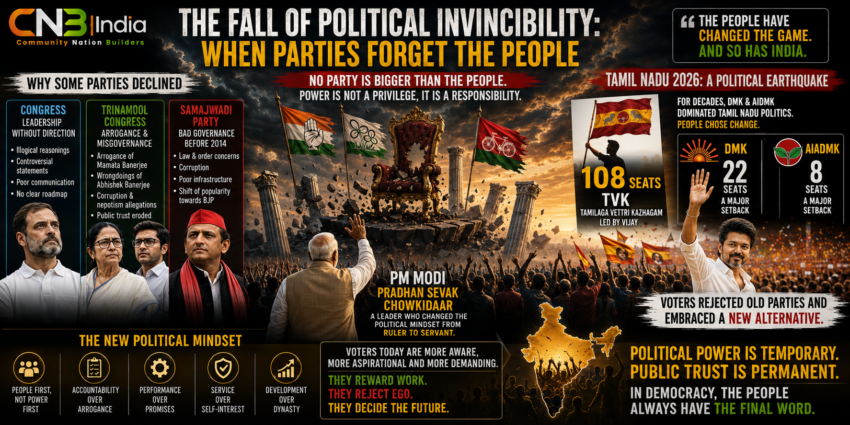
Indian democracy has repeatedly demonstrated a simple but powerful truth:
No political party is bigger than the people.
For decades, several national and regional political parties dominated their states with overwhelming influence. Many leaders appeared politically invincible. Their organizations controlled local politics, their vote banks seemed secure, and their electoral victories created an impression that power would remain with them indefinitely.
Yet history shows that political dominance often carries a hidden danger — complacency.
When leaders begin believing that voters have no alternative, when political organizations become disconnected from grassroots realities, and when power starts looking like entitlement rather than responsibility, decline often follows.
The rise and fall of many political parties across India reflects this reality.
Congress: A Party Searching for Direction
The Indian National Congress was once the dominant force in Indian politics.
However, over the last decade, the party has struggled to regain national relevance despite possessing a vast organizational structure and historical legacy.
Many political observers believe that leadership challenges have contributed significantly to the party’s decline. Critics frequently point to Rahul Gandhi’s political messaging, controversial statements, campaign strategy, and inability to consistently convert anti-incumbency sentiment into electoral victories.
While Congress continues to remain influential in several states, the party has yet to convince large sections of voters that it possesses a clear roadmap and leadership alternative capable of challenging the BJP nationally.
Trinamool Congress: The Risks of Arrogance in Power
Mamata Banerjee successfully ended decades of Left rule in West Bengal and built one of India’s strongest regional political movements.
However, long periods in power often create new challenges.
Critics argue that allegations of corruption involving local leaders, perceptions of political arrogance, organizational factionalism, and controversies surrounding influential leaders within the party have gradually damaged the party’s public image.
Many analysts believe that one of the greatest risks for any political party is assuming that electoral success automatically guarantees permanent public support.
History suggests otherwise.
Samajwadi Party: The Governance Question
The Samajwadi Party remains a major political force in Uttar Pradesh.
However, many voters continue to remember concerns relating to law and order, governance, and administrative effectiveness during previous SP governments.
When Narendra Modi and the BJP campaigned on development, infrastructure, governance, and national aspiration, many voters viewed it as a contrast to earlier political models.
The BJP’s rise in Uttar Pradesh was not simply a victory for one party.
It represented a shift in voter expectations.
Citizens increasingly wanted governance outcomes rather than traditional political calculations.
Tamil Nadu 2026: A Political Earthquake
Perhaps the most dramatic example of changing voter behavior came from Tamil Nadu in 2026.
For nearly six decades, Tamil Nadu politics was dominated by two major Dravidian parties — the DMK and AIADMK.
Many political observers believed that despite changing alliances, power would continue alternating between these two established political forces.
The voters had other plans.
In one of the most surprising election outcomes in recent Indian political history, actor-turned-politician Vijay’s newly formed Tamilaga Vettri Kazhagam (TVK) emerged as the single largest party in its very first Assembly election, ending decades of uninterrupted dominance by the traditional Dravidian parties. TVK won 108 seats, while both DMK and AIADMK suffered major setbacks.
More importantly, internal reviews within the DMK reportedly concluded that party leaders ignored repeated warnings from grassroots workers about the growing popularity of Vijay and the TVK movement. The party reportedly underestimated public demand for change and failed to recognize the scale of support building around the new political force.
The result was not merely an electoral upset.
It was a message from voters.
After decades of choosing between established political options, many citizens decided to place their faith in a completely new political movement.
The rise of TVK demonstrated that voters are willing to abandon even the most deeply rooted political traditions if they believe a new alternative better reflects their aspirations.
The End of the “Ruler” Mindset
One of the biggest political transformations of the last decade has been the changing relationship between citizens and political leaders.
For many years, several political cultures across India revolved around powerful personalities and political dynasties.
Some leaders behaved as though political authority itself guaranteed public loyalty.
Modern voters increasingly reject that approach.
Today’s citizens expect:
- Accountability
- Performance
- Transparency
- Accessibility
- Visible development
They want leaders who solve problems, not merely hold positions of power.
The BJP’s Alternative Narrative
A significant factor behind the BJP’s rise has been its ability to present a different political narrative.
Prime Minister Narendra Modi repeatedly described himself as “Pradhan Sevak” (Chief Servant) and “Chowkidar” (Watchman).
Whether one agrees with the BJP politically or not, these terms carried a symbolic message.
They projected the idea that political leaders are public servants rather than rulers.
Combined with welfare delivery, infrastructure projects, direct benefit transfers, and strong communication, this approach resonated with many voters across regions.
The message was simple:
Power is not a privilege.
Power is a responsibility.
Voters Have Become More Powerful Than Political Legacy
One lesson emerges repeatedly from recent elections:
Family names, political history, and organizational strength are no longer enough.
Modern voters increasingly evaluate leaders based on:
- Performance
- Credibility
- Delivery
- Vision
- Results
Political inheritance may provide visibility.
But public trust must still be earned.
Conclusion
The decline of several once-dominant political parties is not simply a story about individual leaders.
It is a story about changing voter expectations.
From Uttar Pradesh to West Bengal, from national politics to Tamil Nadu’s political revolution, citizens are demonstrating that no political party can take public support for granted.
The BJP’s rise under Narendra Modi accelerated this shift by promoting a politics centered around governance, delivery, and public service.
At the same time, the emergence of TVK in Tamil Nadu has shown that even the strongest political establishments can be challenged when voters feel ignored.
The message from India’s electorate is becoming increasingly clear:
Political power is temporary.
Public trust is permanent.
And in a democracy, the people always have the final word.